|
|
| Mission Statement | Newsletters |
| What's new |
| Become a Member |
| Join e-mail list |
| Projects |
| Videos |
| Wallpaper Images |
| Team Resources |
| Diver Standards |
| Sponsors |
| Contacts |
SCRET Dives a Lockheed PV-2 Harpoon
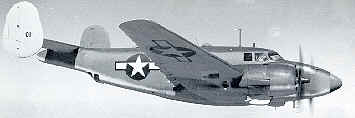
Plane Specifications
Manufacturer: Lockheed (Vega) Aircraft Division
Type: Twin-engine patrol-bomber
Crew: Four or five
Power Plant: two 2000 hp R-2800-31 engines
Dimensions: span, 74 ft. 11 in.; length, 52 ft.; height, 11 ft. 11 in.; wing area, 686 sq. ft.
Weight: empty, 21,028 lbs; gross, 36,000 lb.
Performance: Maximum speed, 282 mph at 13,700 ft.; cruising speed, 171 mph; initial climb, 1,630 ft. per min; service ceiling, 23,900 ft.; range, 1,790 miles.
Armament: five fixed forward-firing 0.5 in. guns in nose; two flexible 0.5 inch guns in dorsal turret. Up to four 1,000 lb. bombs internal and two 1,000 lb. bombs external.
History
The Lockheed PV-2 Harpoon was a major redesign of the PV-1 Ventura to optimize it for the maritime reconnaissance role. The redesign turned out to be so major that it was assigned a new basic model number of Vega Model 15.
The Harpoon shared the same power plant and twin tailed configuration of the Ventura but had longer constant-taper wings, a rectangular tail-plane, larger vertical stabilizers and rudder, increased fuel capacity, increased armament, and a larger bomb bay to completely enclose a torpedo. The new improvements did not make the Harpoons any more popular with their crews.
Some Harpoons saw action during the last year of the (WWII) Pacific campaigns, but most Harpoons were used by US Navy Reserve units after the end of the war. At one time, Harpoons equipped eleven VP squadrons of the Naval Reserve. The Harpoon was finally phased out of service in August 1948. Several Harpoons ended up on the commercial market after being declared surplus to Navy requirements. Some were modified as private transports with deluxe interiors and a few were modified as agricultural spray planes.
PV-2 in Lake Washington
The aircraft is oriented in a nearly vertical position, with the nose buried approximately 11 feet in the silt up to the cockpit windows. The bottom depth at the cockpit windows is 142 feet and the top of the tail is at approximately 105 feet. The condition of the aircraft is fairly good, except for the vertical stabilizers on the tail, which are badly torn.
Click here to see the accident report
Robert Mester has stated that he believes this aircraft is a rare PV2-D "strafer" model of which only 35 were built. The "D" model differed from the standard Harpoon by having a reconfigured nose which held eight fixed forward-firing .50 caliber machine guns instead of the usual five. Because the nose of this aircraft is buried in the mud, the aircraft’s "unique tail configuration and the location of the belly windows" led Mester to this conclusion. On the basis of the rarity of the "D" model, Washington’s Office of Historic Preservation has deemed the aircraft eligible for listing on the National Register of Historic Places and the State Register of Historic places.
The aircraft is the property of the US Navy, which prohibits the removal of artifacts from the site.
The Dive
On Saturday, July 15th, 2000 Two teams of divers visited the plane wreck of a PV2-Harpoon.
The first team of divers (Walter Jaccard, Miranda Aldritt and Kurt Kauth) mission was to simply deploy an upline and explore the plane after the upline has been established. The upline was to be used by a group of people coming out with Bob Mester, of Underwater Atmospheric Systems, Inc who was bringing an ROV to shoot video of the plane. Hooking the plane using standard grapple hook techniques is inadvisable due to the fact that the plane will sustain heavy damage from this technique. The surface team saw the lift bag after approximately 10 minutes of bottom time and hooked a bouy to it. The first team spent the next twenty minutes exploring on the wreck and all surfaced with smiles on their face, a successful dive.
The second team of divers (Kevin Connell and Mark Tourtelout) had a mission of videoing the plane and the ROV in action. After the ROV was ready to go, they left the surface and went directly down the upline to the rear landing gear of the plane. The team spent 30 minutes on the wreck shooting some excellent video. Unfortunately, they never saw the ROV on the bottom and assumed there were some delays. The key parts of the plane that were videoed were the cockpit, escape hatch, radio antennae, bomb bay doors, machine guns, landing gear, and tail surfaces.
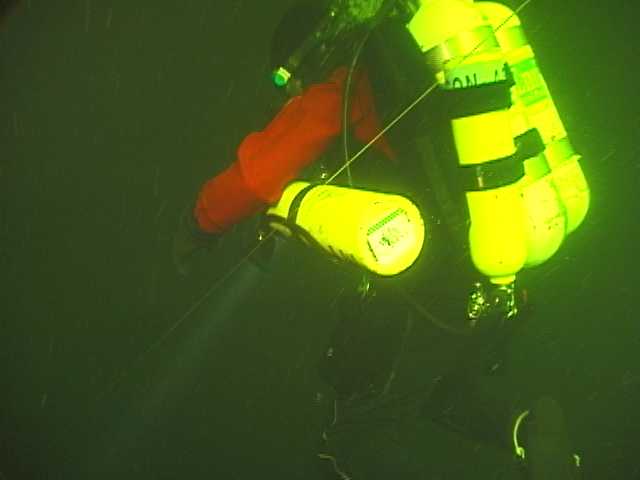
On the descent.
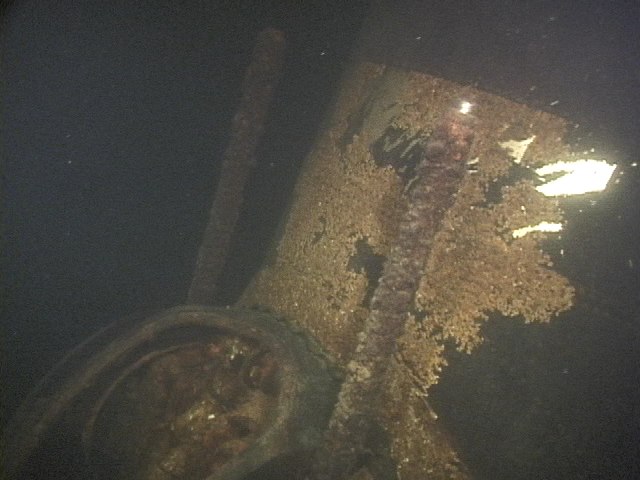
Two shots of the 50 caliber machine guns
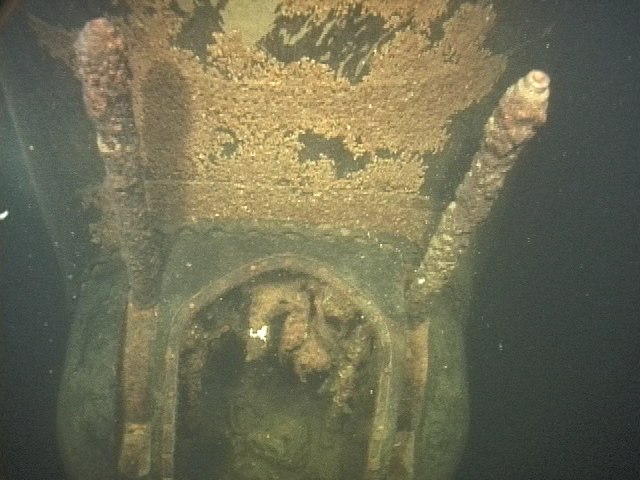
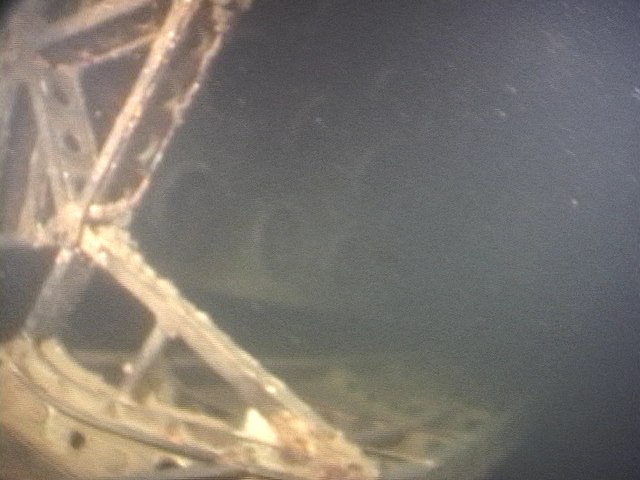
The bomb bay doors
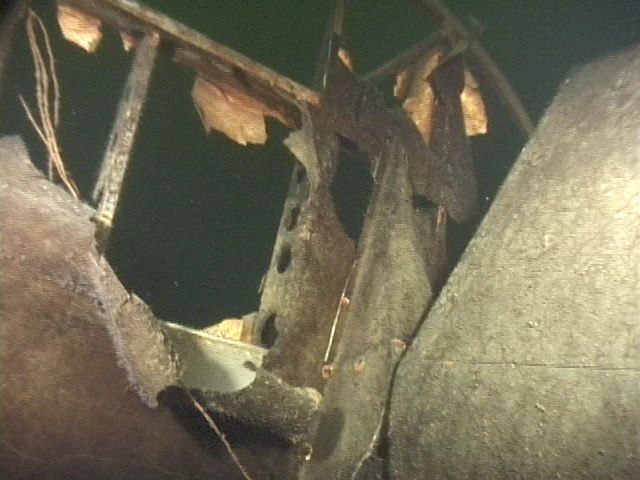
Damage on the horizontal tail surface, possibly from grappling hooks.
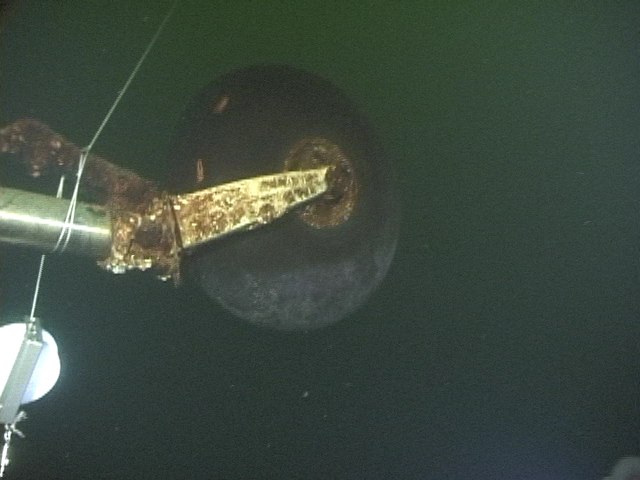
The tail wheel and upline. (Who didn’t take their cave class here????)
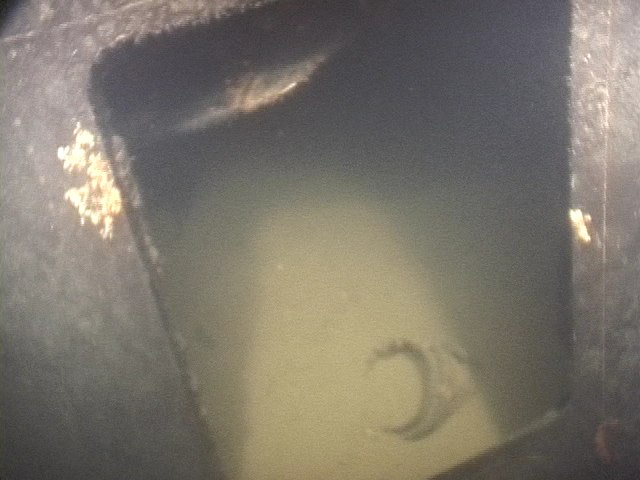
The cockpit viewed from the open escape hatch, buried in silt.
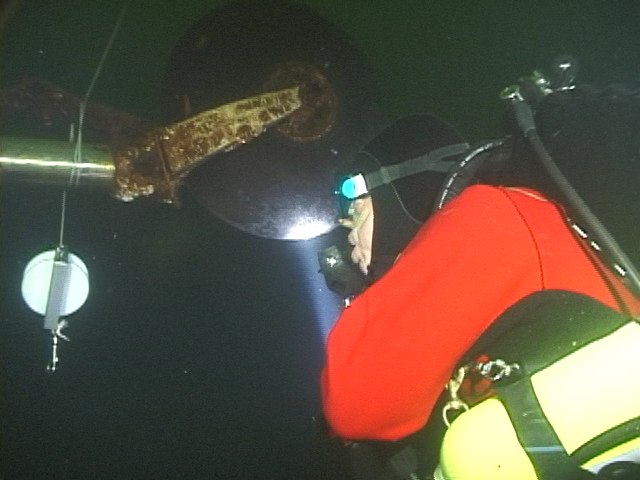
Getting ready to ascend
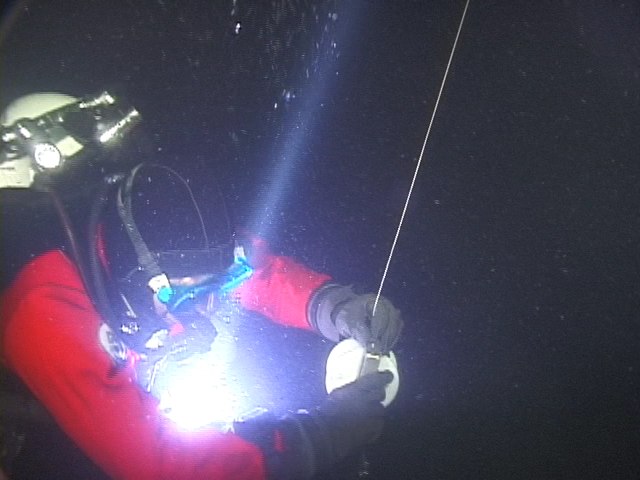
On the ascent. Is that HID blinding you Mark?
Logistics
Each team used 25/35 mix, as per SCRET standards and a single AL30 or 40 of EAN50 for decompression. Bottom time was 30 minutes actual, decompression was a short 15 minutes. Bottom temp was 42 and above 30 it was 60ish. A nice change to have a thermocline to deco in!
Credits/Thanks
Bob Mester – Organizing, Press, and ROV
Jim Kelnhofer – Video Equipment, video captures
Miranda Aldritt – Gas diver
Kevin Connell – Videographer, gas diver, surface support
Walter Jaccard – Gas Diver, surface support, skipper
Kurt Kauth – Gas Diver
Mark Tourtelout – Gas Diver, surface support.